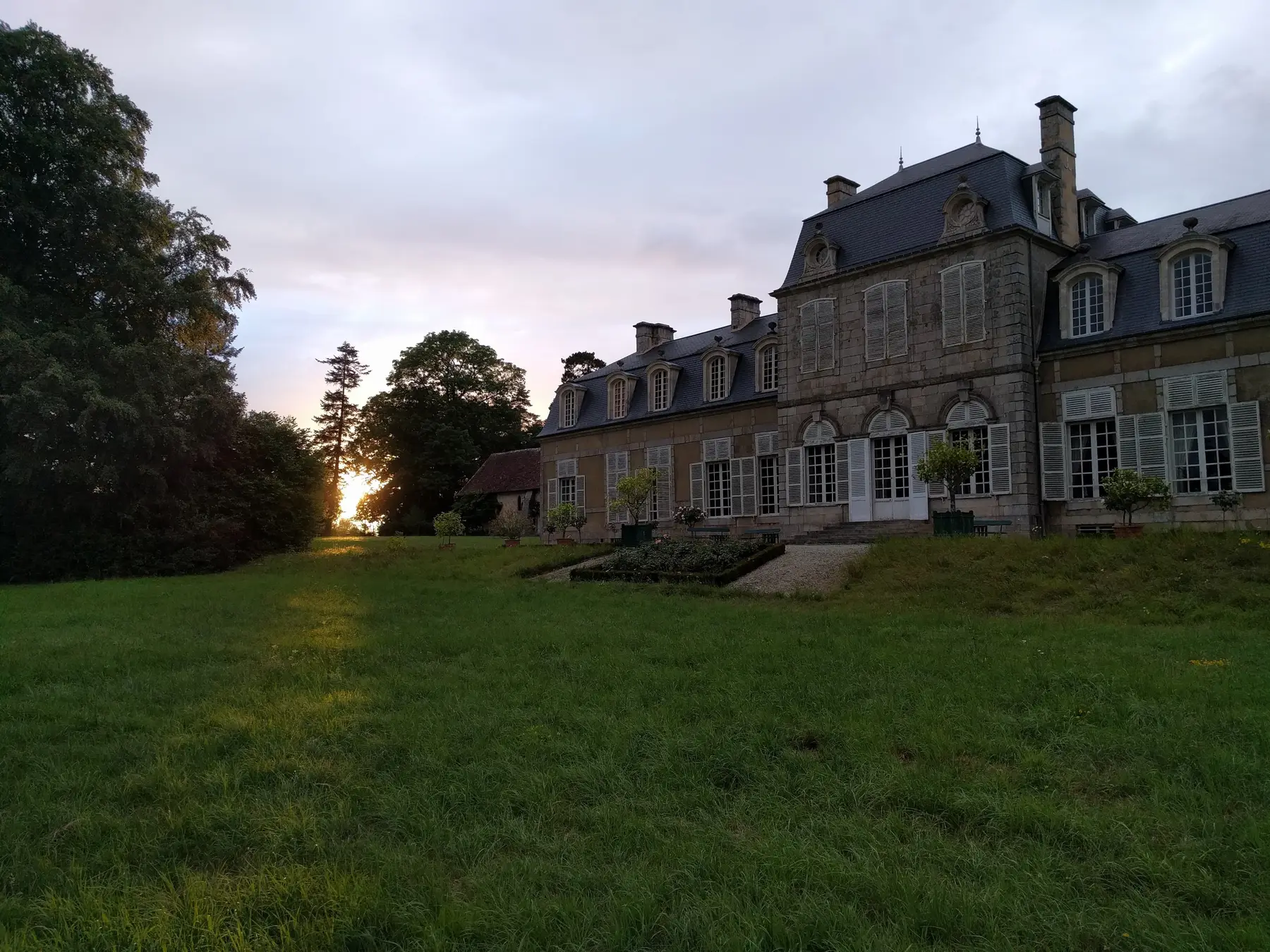
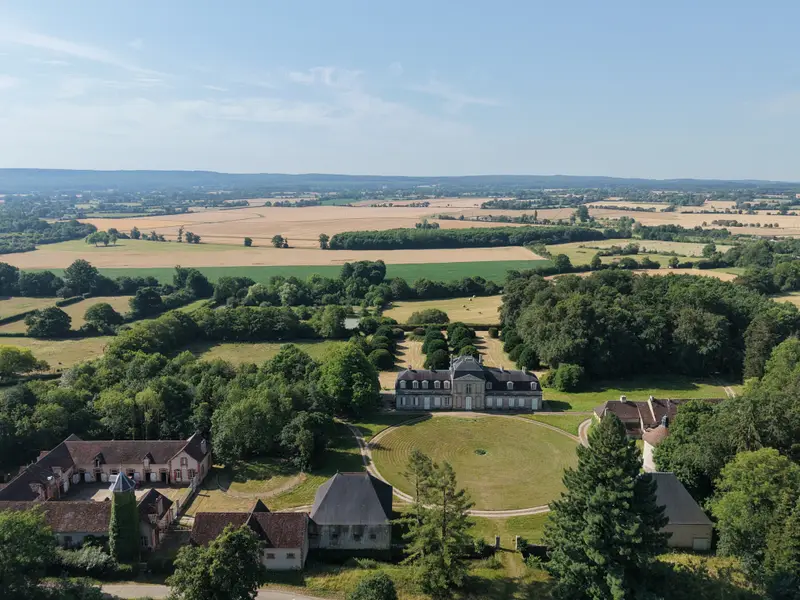
The château seen from the park

Villeneuve-en-Perseigne · Sarthe

Château de Montigny


Explore the estate

History

18th-century castle


Montigny — Montiniacum, Mons ignitus, the burning hill — takes its name from the signal fires once lit on the hilltops.

The earliest known owners of the estate appear to be the Montigneis family, from about 1214 to 1490. The lordship of the parish, attached to the château de la Gasselinière, was held in 1666 by the de la Tousche family; it came under the barony of Saosnois and the jurisdiction of its bailiwick.

The Boullemer family arrives in 1686, in the time of Jacques de Boullemer (c. 1636-1696), lord of Montigny.

The castle was built around 1730 by Jean-Baptiste de Boullemer, lord of Montigny, Fayau, Bresteau, Chassé and La Fresnaye-sur-Chédouet, lieutenant of the marshals of France and first president of the bailiwick and présidial court of Alençon. It was then set in extensive formal gardens, whose ground plan survives. That same year Jean-Baptiste bought a house on the rue du Cygne in Alençon and had it remodelled into the hôtel de Boullemer — today the hôtel Libert, a listed monument — which the family kept until 1805. Pesche hesitates over the birthplace of one of Jean-Baptiste's sons, Father Boullemer, a Jesuit: Alençon or Montigny.

Sold in 1800 by René Nicolas de Boullemer, the castle was bought in 1806 by Hippolyte Le Comte. Pesche, in his Dictionnaire de la Sarthe (1836), records that the buyer was "the same who also acquired that of Sceaux-Penthièvre, near Paris": Jean-François Hippolyte Lecomte, a merchant enriched in the wine trade, purchaser of the Sceaux estate in 1798. He died around 1821, leaving Montigny to his heirs; the family owns it still.

The castle has a central pavilion and two identical wings, with an overall sober appearance.

The north facade of the central pavilion is adorned with a pediment bearing the arms of the Boullemer family and those of the builder's wife, Renée-Michelle Peuvret de Beaulieu, lady of Vieux-Bellême.

The south facade, in its central part, is entirely in Hertré granite, known as Alençon sandstone — a two-mica granite from the Hertré quarries at Condé-sur-Sarthe, worked until the early 20th century. The roof is slate, renewed in the early 2000s. Impressively sized yew trees furnish the meadow.

The castle's mass is balanced to the north by two roughly cubic pavilions, slate-roofed like the castle itself.

To the west we find a dovecote and the old church, disused at the end of the 19th century. Its pointed-arch openings belong to the earliest Gothic, its interior was very plainly decorated and its steeple is a much-shortened spire. It is now used as a woodshed; if you open the door, you can see the remains of a vault in small wooden slats, one beam of which is carved with a floral motif. An adjoining dwelling probably served as a presbytery. Set slightly apart, the old cemetery keeps a cross and a tasteful funerary monument in micaceous Hertré granite, raised to the memory of Hippolyte Le Comte, owner of the castle, who died around 1821.

Inside the castle, you'll see the last wolf shot in the Perseigne forest: a 50 kg animal, killed on 19 March 1888 by an inhabitant of La Fresnaye, and stuffed.

Montigny is a very small commune with no village centre: its heart is the castle and its stud farm, where the tiny town hall found a home. The rest is farms and a few roadside houses — la Gassinière, la Blosserie, les Riaux, la Peignellerie, la Haize, la Rousselière, la Tournardière, le Plessis. The river Sarthe borders two thirds of its perimeter, making the land a kind of peninsula, and the high point, at 156 metres, lies near the castle. In the early 19th century the commune counted twenty-seven hearths and one hundred and thirty-four inhabitants; the population declined from 1804 onwards, and building stone was quarried at la Roirie. Three farms carry on breeding Percheron horses today.

The castle and its estate have been listed as a monument historique by decree of 1 September 2016. The protection covers the facades and roofs of the castle and its pavilions and the entrance hall with its wrought-iron staircase, as well as the former church, the dovecote, the orangery, the laundry, the water tower, the enclosure walls, the moat, the terraces and the grounds of the former gardens.

The château, the stud farm and the plain out to the forêt de Perseigne

Chronology


13th c.
former parish church of Montigny
c. 1214 - 1490
the Montigneis family, earliest known owners of the estate
15th - 16th c.
presbytery, dovecote
1666
the lordship of the parish is held by the de la Tousche family
1686
the lordship of Montigny passes to the Boullemer family
c. 1730
the castle is built by Jean-Baptiste de Boullemer
1800
sold by René Nicolas de Boullemer
1806
bought by Hippolyte Le Comte
c. 1821
death of Hippolyte Le Comte; a funerary monument is raised to him in the old cemetery
19th c.
the parish church is deconsecrated and absorbed into the estate
19 March 1888
the last wolf of the Perseigne forest, a 50 kg animal, is shot by an inhabitant of La Fresnaye
1890
the stud farm and water tower are built
1891
"Qui-Vive" wins the Grand Prix de Vincennes; the stable at its peak
1896 - 1897
the well is drilled, from 28 June 1896 to 26 February 1897, down to granite at 100.85 m
1897 - 1907
Ernest Le Comte sits on the Sarthe departmental council for the canton of La Fresnaye-sur-Chédouet
1911
death of Ernest Le Comte; the trotting stable does not outlive him
1918
the extensions, corridor and terraces are added to the castle
1950
the borehole is abandoned as running water arrives
1999
the December storm fells many trees along the drive, which is replanted
2000 - 2005
the castle roof is renewed
2015
Montigny is merged into the commune of Villeneuve-en-Perseigne
July 2016
a fire destroys the north-west pavilion
1 September 2016
the castle and its estate are listed as a monument historique
2018
the north-west building is rebuilt
2021
the orangery is restored; a rose, emblem of the de Müllenheim family, takes its place on the pediment

Archives


The château before the roof was renewed

Estate

Around the castle


Visit the estate.

19th-century stud farm

Built in 1890 by Ernest le Comte

Montigny was horse country long before the stud farm — Pesche already noted in 1836 that it "raises rather fine foals and young horses, the land being particularly suited to this kind of agricultural industry". At the Blosserie farm, the Lalouet family was among the oldest equestrian families of the Alençon plain, breeding the stallions Hertz, Képi and Ottoman as well as the broodmares Ida and Ordelia, among other mares of merit. The commune's best pastures still carry their names: le Parc des Gazinières, le Type de la Plaine, le Parc de la Butte, the meadows of la Blosserie, the paddocks along the Sarthon and the great park of Lougueuil.

Ernest le Comte, a lawyer in Le Mans, member of the Sarthe departmental council for the canton of La Fresnaye-sur-Chédouet from 1897 to 1907 and passionate about horses, built the horseshoe-shaped stud farm in 1890 to house a stable dedicated to trotters. Its original loose boxes are still in place, as is the wrought-iron footbridge linking two buildings, used to keep watch over the broodmare stables. The stud also keeps its carriages, still brought out for events.

The horse "Postllo" born in 1886 won the Rouen derby in 1889, as did "Qui Vive" born in 1887 who won the same Rouen derby in 1890 in mounted trot. This event is now called the Prix du Cornulier for mounted trotting and the Grand Prix d'Amérique for harnessed trotting, created in 1919.

The stable reached its peak in the early 1890s: "Qui-Vive" — a brown bay by Tigris out of Suzon, with a kilometre record of 1'37" and an approved stallion in the trotter stud book — won the Grand Prix de Vincennes in 1891. In 1892, a history of French trotting published in Le Figaro counted six of M. Lecomte's horses among "the most celebrated": Qui-Vive, Quarantaine, Oriflamme, Orphée, Obéron and Othello.

The stud is currently operated by Mr Daniel Boittin for breeding and stud services. He produces sport horses for the cavalry fanfare of the Republican Guard as well as for hunting with hounds, and draught horses for driving, especially for ceremonies.

Ernest Le Comte died in 1911 without a successor to maintain the stable.

A small corner of this prestigious complex hosts the local town hall.

The water tower and its borehole

A 100-metre borehole, with a pump powered by a single-cylinder gasifier engine

It followed shortly after the stud farm. The geological section drawn up for Mr Le Comte, kept at the château, dates the work precisely: begun on 28 June 1896, the borehole was finished on 26 February 1897, at 100.85 metres, in granite. It was the work of Édouard Lippmann & Cie, civil engineers; pumping tests yielded 5,440 litres an hour.

A small building, about a hundred metres north of the stud, houses the borehole: water extraction is provided by a reciprocating pump driven by a gasifier engine — a patented wood-gas producer made in Bonnétable, in the Sarthe. You can see the gas-generating hearth and the single-cylinder motor driving the pump; thus the water arrived at the foot of the water tower, built of stone and brick and topped with a slate lantern.

This engine also produced electrical energy stored in accumulator batteries, kept in a small adjoining room. Electric lighting thus existed at the castle and in the stables long before the public network reached the commune.

The water tower, built at the same time as the stables, provided the horses with running water which, brought to the foot of the water tower from the borehole, was propelled upwards by a horse-drawn carousel; under a trap door, the gear train of this mechanism can still be seen.

Ernest Le Comte thus laid on running water for his horses before the castle itself had any.

South-facing glass orangery

Brick and stone, with tall glazed bays facing south; restored in 2021

Built of brick and stone, the orangery opens wide glazed bays to the south between masonry piers, under an arched pediment flanked by stone balls.

Its roof and ceiling needed renewing: this was done in 2021, and a rose, the emblem of the de Müllenheim family, took the place left empty at the centre of the pediment.

A 13th-century chapel

Desecrated in the 19th century, its presbytery has since become a dwelling

The former parish church of Montigny, under the patronage of the Virgin: its parish gathering was held on 8 September, feast of the Nativity, "from time immemorial". Deconsecrated during the 19th century and since absorbed into the estate, its pointed-arch openings belong to the earliest Gothic, its interior was very plainly decorated and its steeple is a much-shortened spire. It now serves as a woodshed; the remains of a vault of small wooden slats can still be made out inside, one beam carved with a floral motif, along with a few traces of wall paintings.

Set slightly apart, the old cemetery keeps a cross and a funerary monument in micaceous Hertré granite, raised to the memory of Hippolyte Le Comte, who died around 1821.

The dovecote

A cylindrical dovecote crowned with a slate lantern

The dovecote most likely dates from the 15th or 16th century, well before the present castle. Its cylindrical tower carries a conical tiled roof, pierced by a dormer and topped with a slate lantern.